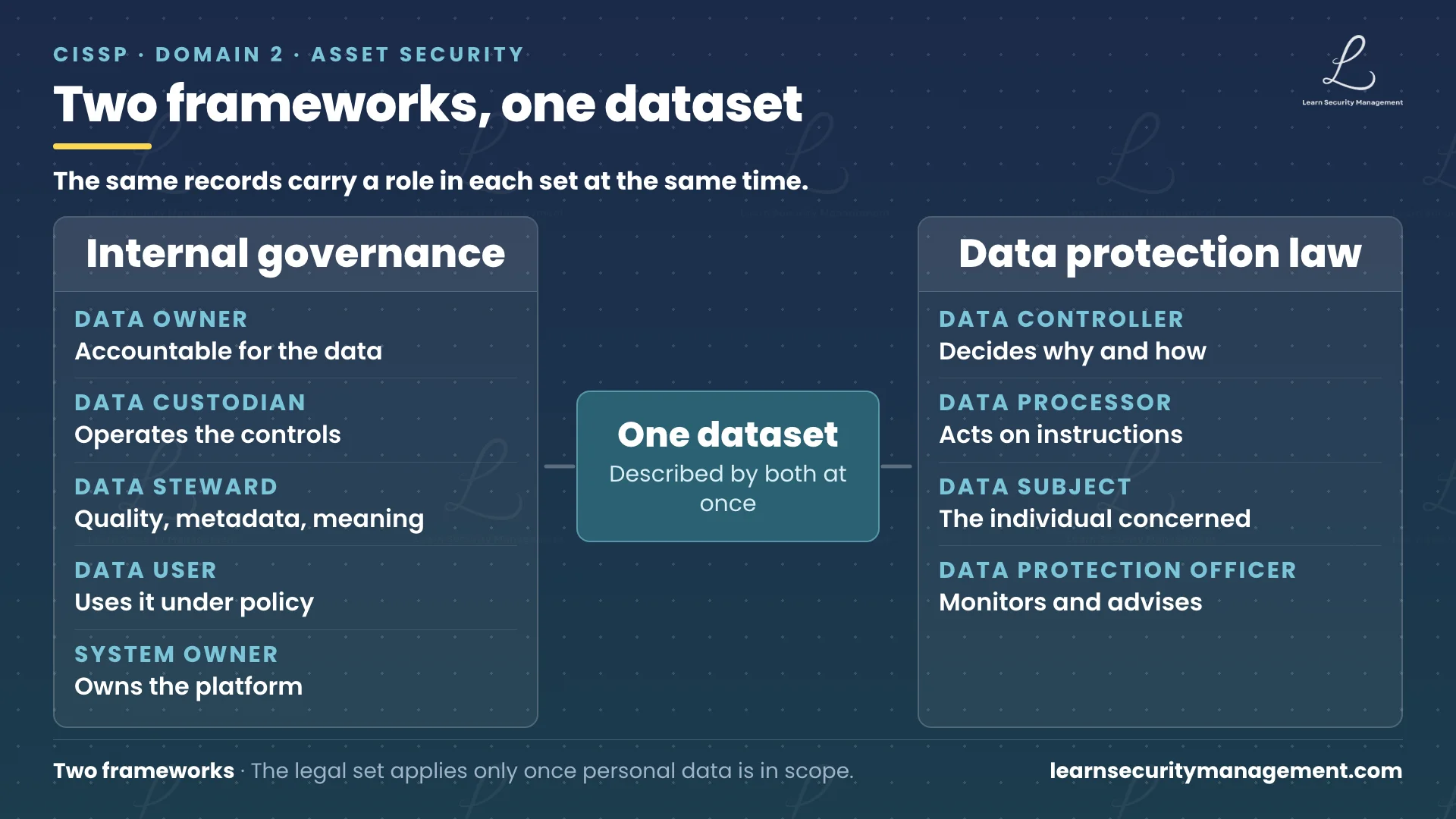
Data security roles define who is accountable for information and who is merely responsible for handling it. The internal governance set names a data owner, custodian, steward, user and system owner. Data-protection law names a controller, processor, data subject and Data Protection Officer. One rule runs through both: you can delegate the work, never the accountability.
The reason there appear to be so many roles is that two separate frameworks describe the same data at the same time, and the same person can hold a role in each. Every control in asset security assumes a named party stands behind the data, which is why “no assigned owner” is among the most damaging findings an asset programme can produce. Once personal data is involved the roles also carry legal weight, and misreading them has consequences regulators act on. This guide separates the two frameworks, works through the pairings that decide close questions, and shows every role placed on a single real data flow.
What are data security roles?
A data security role is a named position of answerability for information. It is not a job title and it is not a team. A single person can hold several roles, one role can be held by a department, and the same individual can be a data owner internally while their employer is a data controller in law.
Roles exist because controls need an anchor. Classification needs somebody to set the level. Handling rules need somebody to enforce them. Secure provisioning needs somebody to authorise the access and somebody else to configure it. Strip the roles away and every one of those controls loses the party who decides it and the party who answers for it.
Accountability against responsibility
The whole subject turns on a distinction that ordinary English blurs and governance vocabulary does not.
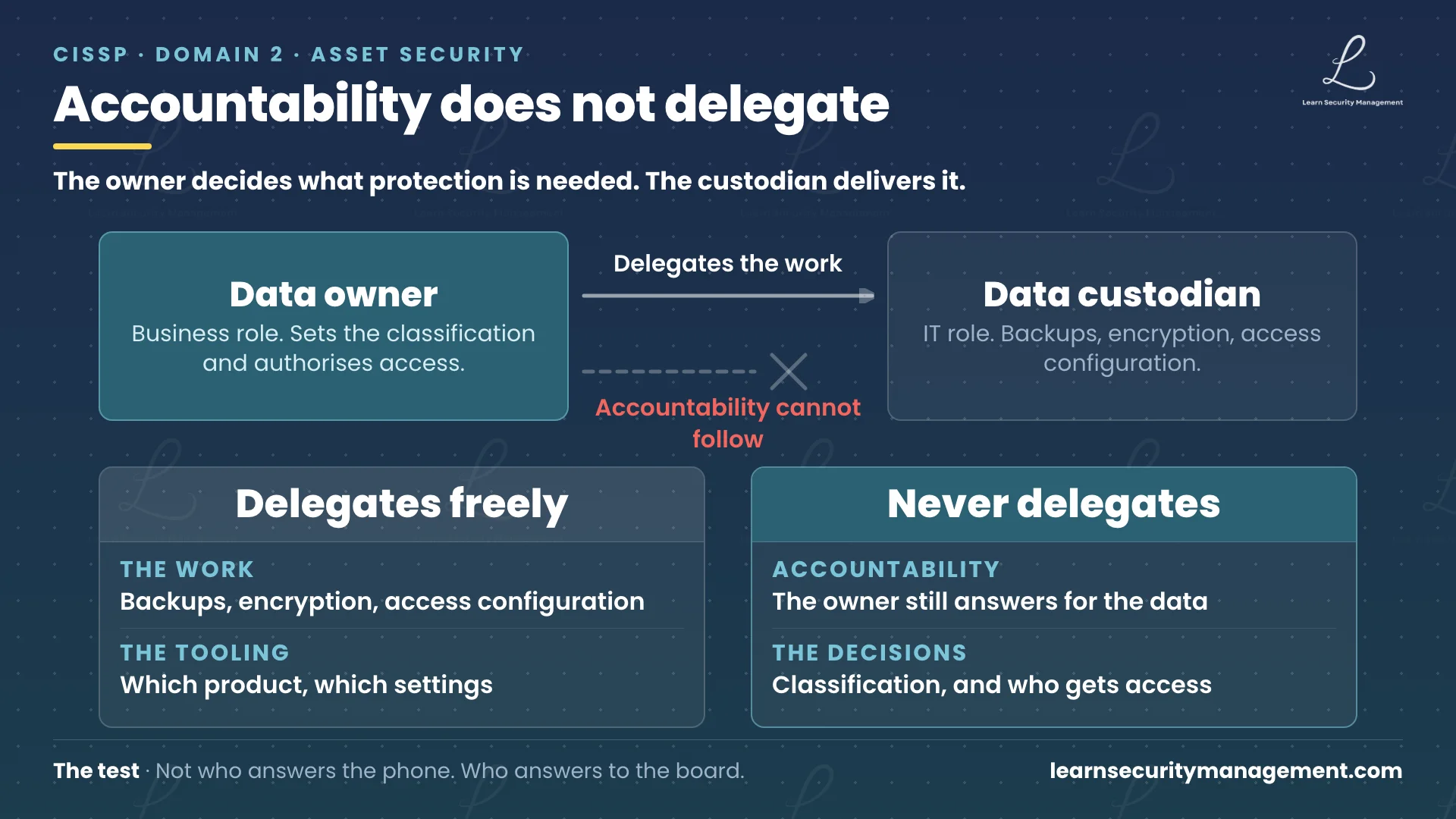
Accountability is ultimate answerability. It cannot be delegated. The accountable party carries the consequences when the data is mishandled, and no contract or outsourcing arrangement moves that. Reassigning the role itself is a different matter: an organisation can name a new owner, and accountability moves with the appointment. What it cannot do is keep the role and hand the answerability to somebody else.
Responsibility is doing the work. It can be delegated freely, and usually is. The responsible party performs the task and reports on it, but does not carry the final consequence.
The two are not mutually exclusive: an accountable role often does work of its own, and the data owner both answers for the dataset and personally makes the classification and access decisions. What a security policy has to avoid is leaving accountability unnamed, because it then settles by default on whoever operates the system, and that is the one place it does not belong.
Two frameworks over one dataset
The roles arrive from two directions, and treating them as one flat list is what makes the topic feel crowded.
Internal governance roles manage the data as an organisational asset: data owner, custodian, steward, user, system owner. NIST SP 800-18 supplies the information owner and the information system owner; custodian, steward and user come from general security governance practice rather than one named standard. All of them apply to every dataset regardless of what it contains.
Legal and regulatory roles fix responsibility under data-protection law: controller, processor, data subject, Data Protection Officer. They come from GDPR and its equivalents, and they apply only where personal data is in scope.
The two sets overlap on the same records without merging. A finance director can be the internal data owner of the payroll dataset while the employing company is the data controller for the same information. Neither role displaces the other, and a scenario will usually signal which framework it is asking about by whether it mentions the law.
The internal governance roles
The internal set is a chain of decision and execution, and for the data itself it has exactly one accountable link.
Data owner: accountable, and that accountability does not delegate
The data owner, sometimes called the information owner, is the senior or business role accountable for a dataset throughout its life. The owner sets the data classification level, defines acceptable use, authorises who may have access, and answers for the data when it is questioned.
The role sits in the business rather than in IT, and that placement is deliberate. Only the business can judge what the data is worth, what its disclosure would cost, and what regulatory exposure it carries. An IT function asked to classify data it does not own will classify by technical convenience, which is how organisations end up with everything marked internal.
Accountability stays with the owner because only the business can carry the consequences. That is the reason it survives delegation.
Data custodian: responsible for carrying out the owner’s decisions
The data custodian is the operational role, normally IT or operations, responsible for implementing and maintaining the controls the owner requires. Backups, encryption, access configuration, patching, media handling and retention mechanics all sit here.
The custodian is responsible, not accountable. A custodian who follows the owner’s instructions correctly has discharged the role even if those instructions were wrong, and a custodian who improvises a classification decision has stepped outside it.
That boundary is easy to state and routinely crossed. The most common internal failure is letting the custodian make the business risk decisions, either because no owner was ever named or because the named owner declines to engage. Both produce the same outcome: protection chosen by whoever was closest to the keyboard.
Data steward, data user and system owner
Three further internal roles complete the set, and each is distinguished from the owner by a single question.
The data steward is responsible for data quality, metadata and business meaning: making sure a field means what it claims, that records are accurate, and that the dataset is fit for its purpose. A steward looks after what the data says. An owner decides how far it may travel.
The data user is anyone who accesses data to perform their duties, bound by the acceptable-use policy and by the handling rules that follow from the classification. Users are the largest group and the one the other roles’ decisions are ultimately aimed at.
The system owner is accountable for the IT system or platform that stores or processes the data, as distinct from the data owner who is accountable for the information itself. The two are separated because they often do not align: one platform commonly carries data belonging to several owners, and one dataset commonly spans several platforms. A business or mission owner, where the term is used, is accountable for the process the data serves and is often the data owner’s organisational home.
The legal and regulatory roles
The legal set turns on a different question from the internal set. Where internal governance asks who decides and who executes, data-protection law asks who determined the purpose.
Controller, processor and data subject
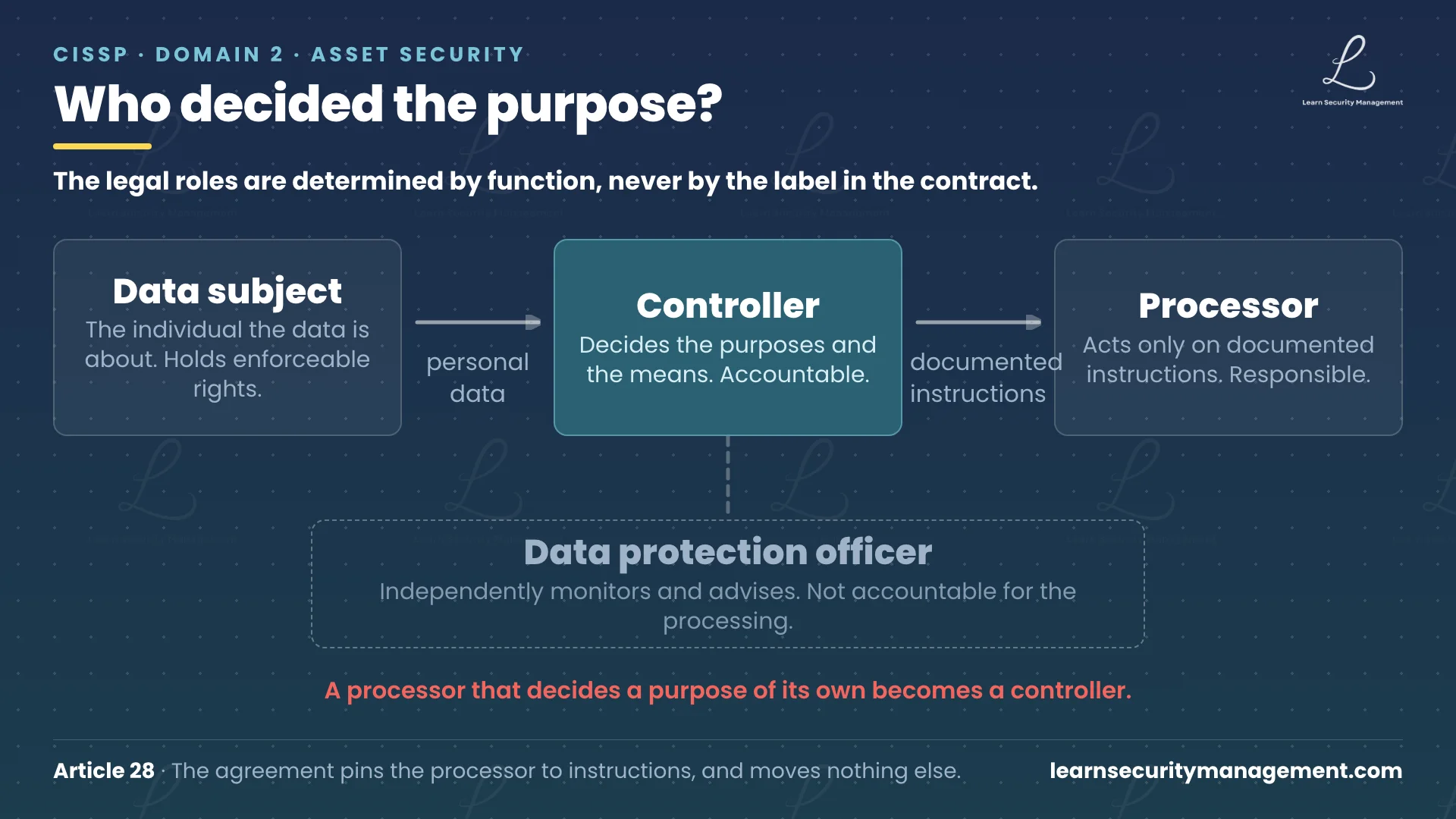
The data controller is the entity that determines the purposes and the means of processing personal data: the why and the how. The controller bears primary legal accountability for lawful processing, both to the supervisory authority and to the individuals concerned.
The data processor processes personal data on behalf of, and on the documented instructions of, the controller. A processor cannot decide the purpose for itself. Cloud hosts, SaaS platforms, analytics firms and payroll bureaux are the standard examples. Being responsible rather than accountable does not make a processor untouchable: it carries statutory duties of its own, and under Article 82(2) it can be liable directly to an affected individual where it breaches an obligation aimed specifically at processors or acts outside the controller’s lawful instructions.
The data subject is the identified or identifiable individual the personal data is about, holding enforceable rights over it: access, erasure, portability and objection among them. The data subject is the only role in either framework that is a person by definition rather than by appointment.
When a processor becomes a controller
A processor that begins deciding purposes for itself stops being a processor. It becomes a controller in its own right, and it acquires controller accountability along with the status, whatever the contract calls it.
This is not a technicality. A vendor engaged to process customer records that starts mining those records to improve its own product has determined a new purpose, and the legal characterisation follows the behaviour rather than the paperwork.
The controller-processor agreement, required by GDPR Article 28, exists to prevent exactly that drift. It binds the processor to the controller’s instructions and defines its security obligations. Operating without one leaves the controller exposed on a point that is straightforward to prove.
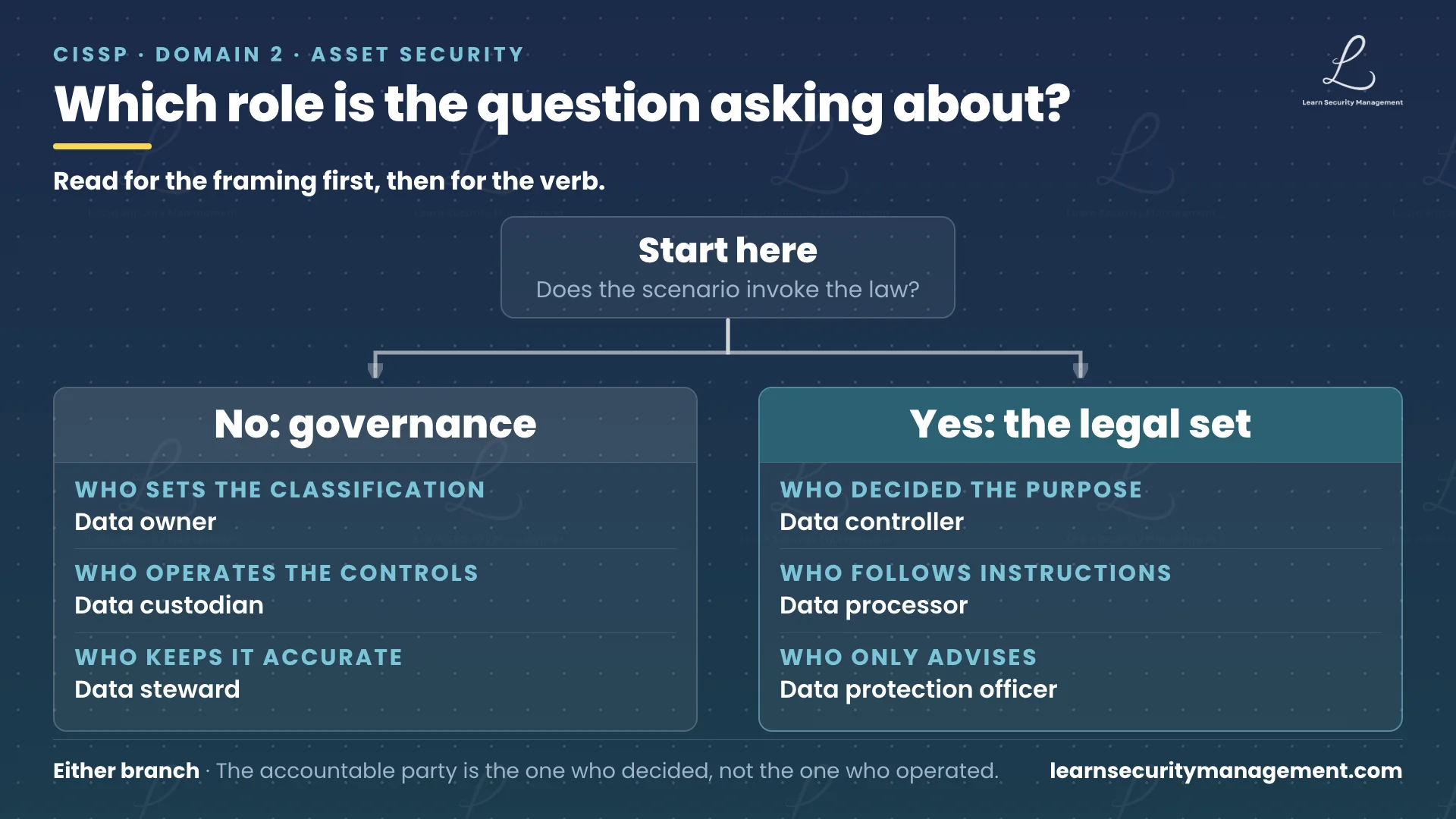
CISSP Exam Note: Roles in data-protection law are determined by function, not by label. A scenario describing an organisation that decides why personal data is processed is describing a controller, even if the contract calls it a service provider. Read for who set the purpose.
The Data Protection Officer
A Data Protection Officer, required for certain organisations, independently monitors data-protection compliance, advises management, and is the contact point for the supervisory authority and for data subjects.
The role is advisory. A DPO does not become accountable for the processing, and the controller does not discharge its own accountability by appointing one. The independence is legally protected, which means an organisation that appoints a DPO and then directs the role’s conclusions has created a second compliance failure on top of whatever prompted it.
Three failures cluster here: not appointing a DPO where the law requires one, appointing one and treating them as the accountable party, and appointing one and undermining the independence the role depends on.
Every role on one page
| Role | Framework | Accountability | Core duty |
|---|---|---|---|
| Data owner | Governance | Accountable | Sets classification, authorises access |
| Data custodian | Governance | Responsible | Operates and maintains controls |
| Data steward | Governance | Responsible | Data quality, metadata and meaning |
| Data user | Governance | Responsible | Uses data under the acceptable-use policy |
| System owner | Governance | Accountable | Answers for the platform, not the information |
| Data controller | Legal | Accountable | Determines purposes and means of processing |
| Data processor | Legal | Responsible | Processes on documented instructions only |
| Data subject | Legal | Rights holder | The individual the personal data is about |
| Data Protection Officer | Legal | Advisory | Monitors compliance, advises, liaises with the regulator |
A worked example: outsourcing payroll
One pay run places every role, which is why payroll is the example worth memorising.
A company runs its payroll through a cloud SaaS provider. The company decides why employee pay data is processed and how, so the company is the data controller and carries primary legal accountability. The SaaS provider processes that data only on the company’s documented instructions, so the provider is the data processor, bound by a controller-processor agreement. The employees whose salaries are processed are the data subjects, with rights over their own records.
Inside the company, the same flow carries the internal set. The finance director who owns the payroll dataset, sets its Confidential classification and authorises who may see it is the data owner. The IT team maintaining the access controls, encryption and backups is the data custodian. The team that reconciles pay codes and keeps the reference data accurate acts as data steward. An analyst running a payroll report is a data user. The platform team answering for the HR system itself is the system owner. The company has also designated a DPO, who independently monitors that the processing stays lawful.
CISSP Exam Note: Payroll on its own would not make that DPO mandatory, and the reason is a distinction worth holding on to. Article 37(1) requires a DPO only where the organisation is a public authority, or where its core activities involve regular and systematic monitoring of individuals on a large scale, or large-scale processing of special categories of data. Paying your own employees is a support function rather than a core activity, so it falls outside all three. Article 37(4) permits a voluntary appointment anyway, and a voluntarily appointed DPO carries the same duties and the same protected independence as a mandatory one. Watch for scenarios that offer volume or sensitivity as the trigger; the test is whether the processing is a core activity.
One data flow, nine roles, and the point the scenario is usually built around: the company’s accountability as both controller and owner does not move to the SaaS provider merely because the provider does the processing.
How the roles connect to the rest of asset security
Roles are not a standalone topic. They are the layer that makes the other asset security controls executable, and questions frequently reach this subject through one of them.
Classification is the clearest case. A classification scheme is a set of labels until somebody with authority applies them, and that authority is the data owner’s. The data classification level then dictates handling, storage and transmission rules, which the custodian implements across all three data states.
Retention and disposal work the same way. The owner sets how long data is kept and when it is destroyed; the custodian executes the destruction and is responsible for ensuring no data remanence survives it. A data loss prevention deployment likewise depends on owner-set classification to know what it is looking for, which is why DLP programmes launched without an ownership model tend to produce rules nobody can justify.
The pattern repeats: the owner supplies the decision, the custodian supplies the mechanism, and a control missing either one does not hold.
Where the roles get confused
Four confusions tend to account for most of the difficulty in this area, and each has a distinct cause.
Owner confused with custodian. The cause is that the custodian is more visible: they run the systems, appear in the tickets and answer the day-to-day questions. Test it by asking who would answer to the board, not who would answer the phone.
Controller confused with processor. The cause is that both handle the data, sometimes with the processor handling far more of it. Volume is irrelevant. Test it by asking who decided the purpose.
Accountability believed to be outsourced. The cause is that commercial contracts genuinely do transfer many things, so it seems reasonable that they transfer this. They do not. A contract can allocate cost and can create a right to be indemnified, and neither of those is the same as the regulator’s view of who was answerable.
DPO mistaken for the accountable party. The cause is that the DPO is the most visibly data-protection-shaped role in the organisation. Independence is the tell: a role required to be independent of the processing cannot be accountable for it.
Conclusion
Data security roles are how accountability is fixed to information and kept from dissolving. The internal governance set makes the data owner accountable and the custodian responsible, with the steward, user and system owner filling in around them. The legal set makes the controller accountable and the processor bound to instructions, with the data subject holding rights and the DPO advising. Two frameworks, one dataset, and the same principle underneath both.
The manager’s test cuts through most scenarios in a sentence: for this data, who answers when it goes wrong? If the honest answer is “the IT team” or “the vendor”, the accountability has been misplaced, because operating the controls and deciding the purpose are not the same thing as being answerable for the outcome. Delegation moves work. It never moves answerability.
Questions in this area tend to reward candidates who can separate the two pairings under time pressure rather than recite the definitions. Our LSM CISSP practice tests drill exactly these scenarios: owner against custodian, controller against processor, who retains accountability after outsourcing, and where the DPO sits, with full explanations for every answer.
Quick reference for the CISSP exam
The internal governance roles
- Data owner: accountable. Sets classification, defines acceptable use, authorises access. Sits in the business.
- Data custodian: responsible. Operates and maintains the controls the owner specifies. Usually IT.
- Data steward: responsible for data quality, metadata and business meaning.
- Data user: uses data under the acceptable-use policy and the handling rules.
- System owner: accountable for the platform, not for the information it holds.
The legal and regulatory roles
- Data controller: accountable. Determines the purposes and means of processing personal data.
- Data processor: responsible. Processes only on the controller’s documented instructions.
- Data subject: the individual the personal data is about. Holds enforceable rights.
- Data Protection Officer: advisory and independent. Monitors, advises, liaises with the supervisory authority.
Data owner against data custodian
- The owner decides what protection the data needs; the custodian delivers it.
- The owner is accountable and cannot delegate that; the custodian is responsible and the work can be reassigned freely.
- If a scenario describes somebody setting a classification or approving access, it is describing the owner.
Data controller against data processor
- The controller decides the purposes and means; the processor acts on documented instructions.
- A processor that decides a purpose of its own becomes a controller and takes on that accountability.
- A controller-processor agreement, required by GDPR Article 28, pins the processor to instructions. It does not move the controller’s accountability.
Common mistakes
- Treating the custodian as accountable because the custodian is the visible operator.
- Deciding controller against processor by who handles more data, rather than by who set the purpose.
- Believing that outsourcing the processing outsourced the accountability.
- Treating a Data Protection Officer as accountable for processing, when the role is advisory and independent.
- Merging the data owner and the system owner, which are separated precisely because they often do not align.
- Applying an internal governance term such as “data owner” to what is actually a legal relationship.
Spotting the topic in a scenario
Wording about who should classify data, who approves access, or who answers for a dataset points at the internal governance roles. Wording about personal data, lawful processing, individuals’ rights, supervisory authorities or a written processing agreement points at the legal roles. Where a scenario describes an outsourcing arrangement and then asks about liability or accountability, the answer almost always turns on accountability having stayed where it started.