The Bell-LaPadula model is a security framework designed to protect classified information by controlling how data flows within a system. Unlike integrity-focused models, Bell-LaPadula has one job: maintaining confidentiality. It prevents unauthorized users from accessing sensitive information, and it stops authorized users from leaking that information, accidentally or otherwise, to lower security levels.
Decades after it was developed for the US military, this confidentiality model remains one of the most important access control frameworks in security architecture. Where the Biba model protects data integrity, Bell-LaPadula protects secrets from unauthorized disclosure. That distinction is essential for CISSP candidates, particularly in Domain 3 (Security Architecture and Engineering), where access control models are tested heavily. You can find a quick definition in our glossary entry for the Bell-LaPadula model; this guide covers everything the exam expects you to know.
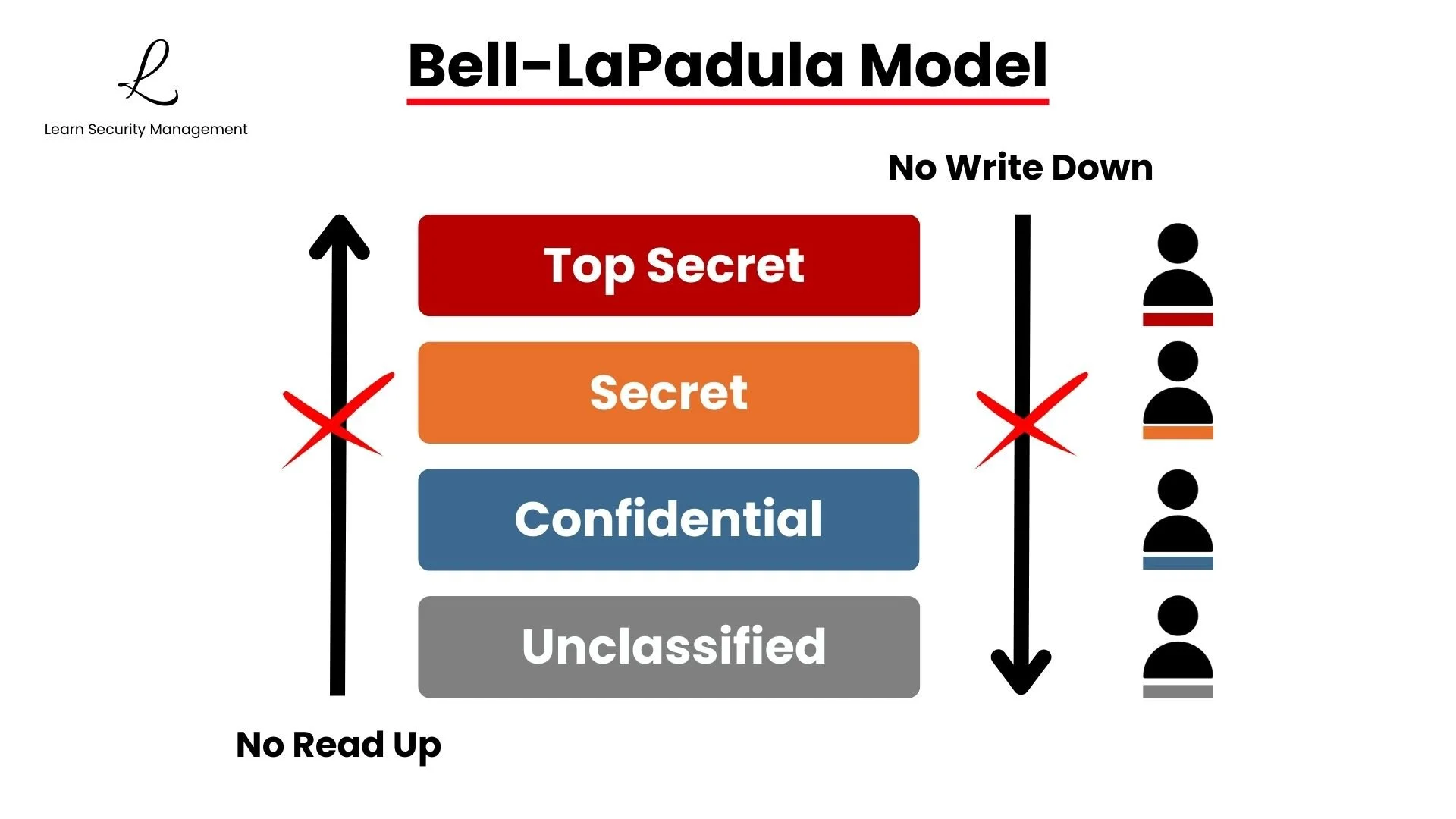
What is the Bell-LaPadula Model?
The Bell-LaPadula model controls how data flows within a system so that classified information can never reach someone who is not cleared to see it. Every access decision serves that single goal.
Bell-LaPadula is also the most famous example of Mandatory Access Control (MAC). In a MAC environment, the operating system constrains what a subject (a user or process) can do to an object (a file or resource) based on rule-based security labels. Users cannot simply share files at their own discretion. Discretion is exactly what Discretionary Access Control (DAC) allows, and it is exactly what MAC forbids: if you handle state secrets, “I decided to share it” is not an acceptable access model.
Core Purpose: Confidentiality Protection
Think about what confidentiality means compared to integrity. Integrity ensures data remains accurate and unmodified. Confidentiality ensures data remains secret from unauthorized viewers. Consider a military intelligence agency where classified documents must be protected from unauthorized access, or a government department handling national security information. In those environments, unauthorized disclosure could be devastating even if every byte of the data stayed perfectly accurate.
Key concept: confidentiality vs integrity. Confidentiality keeps data secret from unauthorized viewers. Integrity keeps data accurate, complete, and unmodified by unauthorized sources. The Bell-LaPadula model exclusively addresses confidentiality: it has no mechanisms for protecting integrity or availability.
The model operates on a simple premise: information should only flow in directions that preserve secrecy. Classified data should never be exposed to users without proper clearance, and users should never write sensitive information to locations where less-cleared individuals can read it. That controlled flow is the foundation of the model’s two core rules.
Security Levels and Clearances
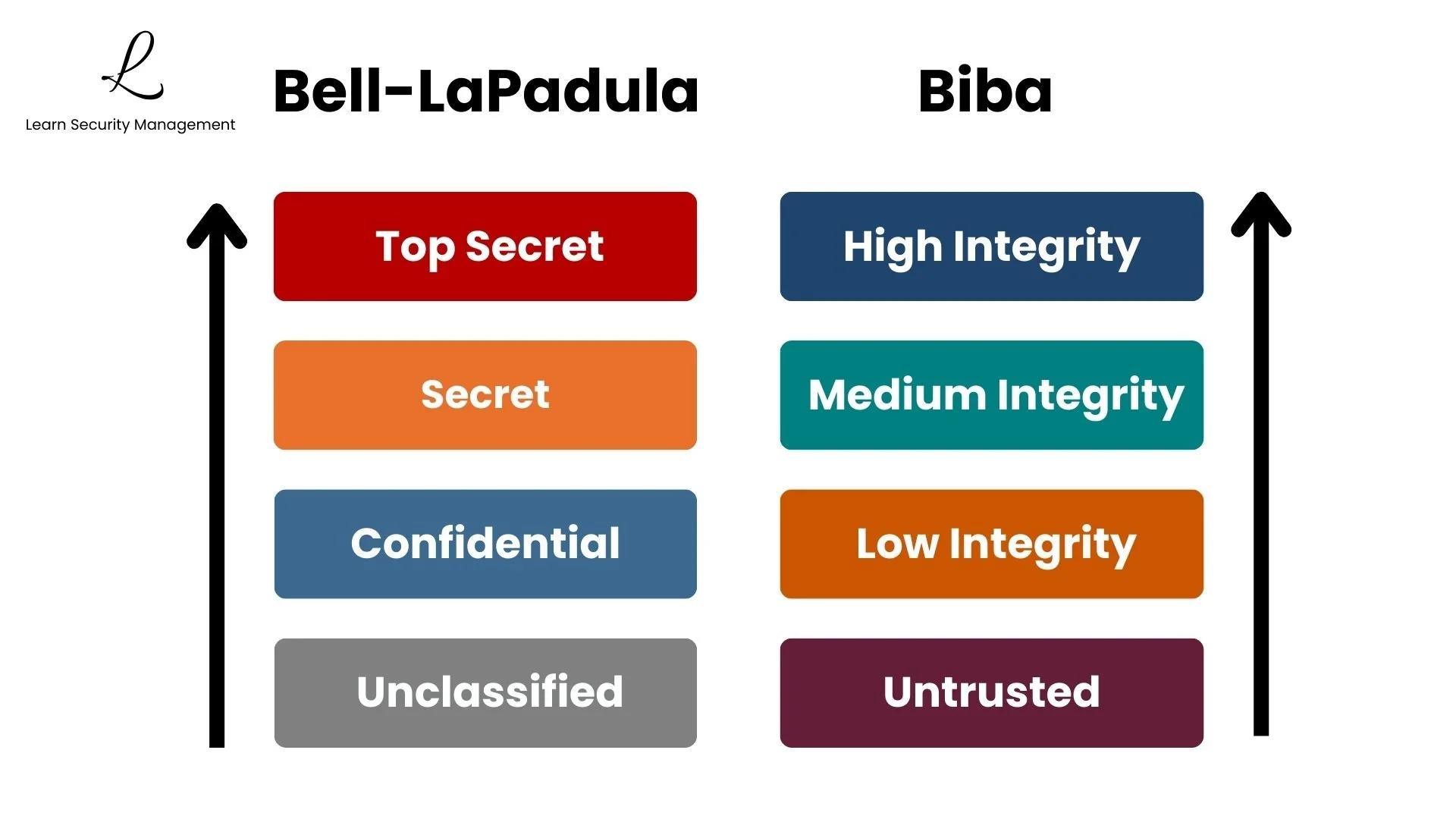
Before the rules make sense, you need to see how Bell-LaPadula organises information and people. Every piece of data gets a classification level, and every user gets a clearance level. The levels form a hierarchy from most to least sensitive:
| Classification level | Description | Example data |
|---|---|---|
| Top Secret | Highest sensitivity, grave national security impact | Intelligence operations, nuclear codes |
| Secret | High sensitivity, serious national security impact | Military plans, diplomatic communications |
| Confidential | Moderate sensitivity, damage to national security | Logistics data, personnel records |
| Unclassified | Public or non-sensitive information | Press releases, public documents |
Your clearance determines the maximum classification you can access. Think of clearance as a trust rating: Top Secret clearance means you have been vetted to handle the most sensitive information, while lower clearances limit you to less sensitive material.
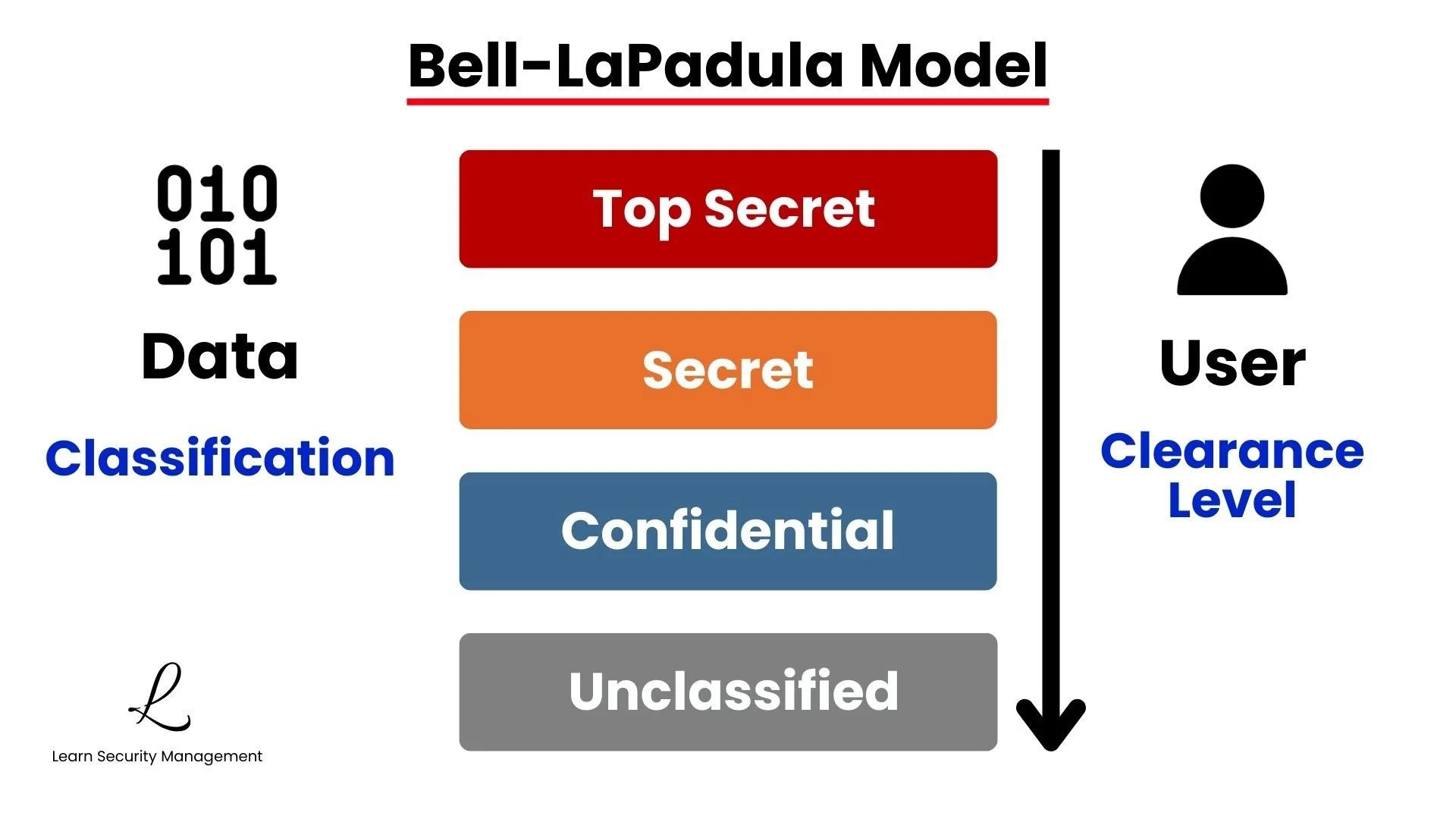
CISSP Exam Note. Security levels in Bell-LaPadula reflect sensitivity, not trustworthiness. A document can be Unclassified (not sensitive) and still be high integrity (verified and accurate) at the same time. Sensitivity and integrity are independent properties, and the exam probes whether you keep them separate.
The Two Core Properties
Bell-LaPadula enforces confidentiality through two rules that control information flow. One blocks unauthorized reading; the other blocks accidental (or deliberate) leakage through writing. You need both, because a secret that cannot be read directly can still be copied to somewhere it can be read.
Simple Security Property (No Read Up)
The Simple Security Property is the intuitive one: you cannot read above your clearance level. Your clearance must be at or above the data’s classification. It is often called the “read down” rule, because you can read at your level or lower, never above.
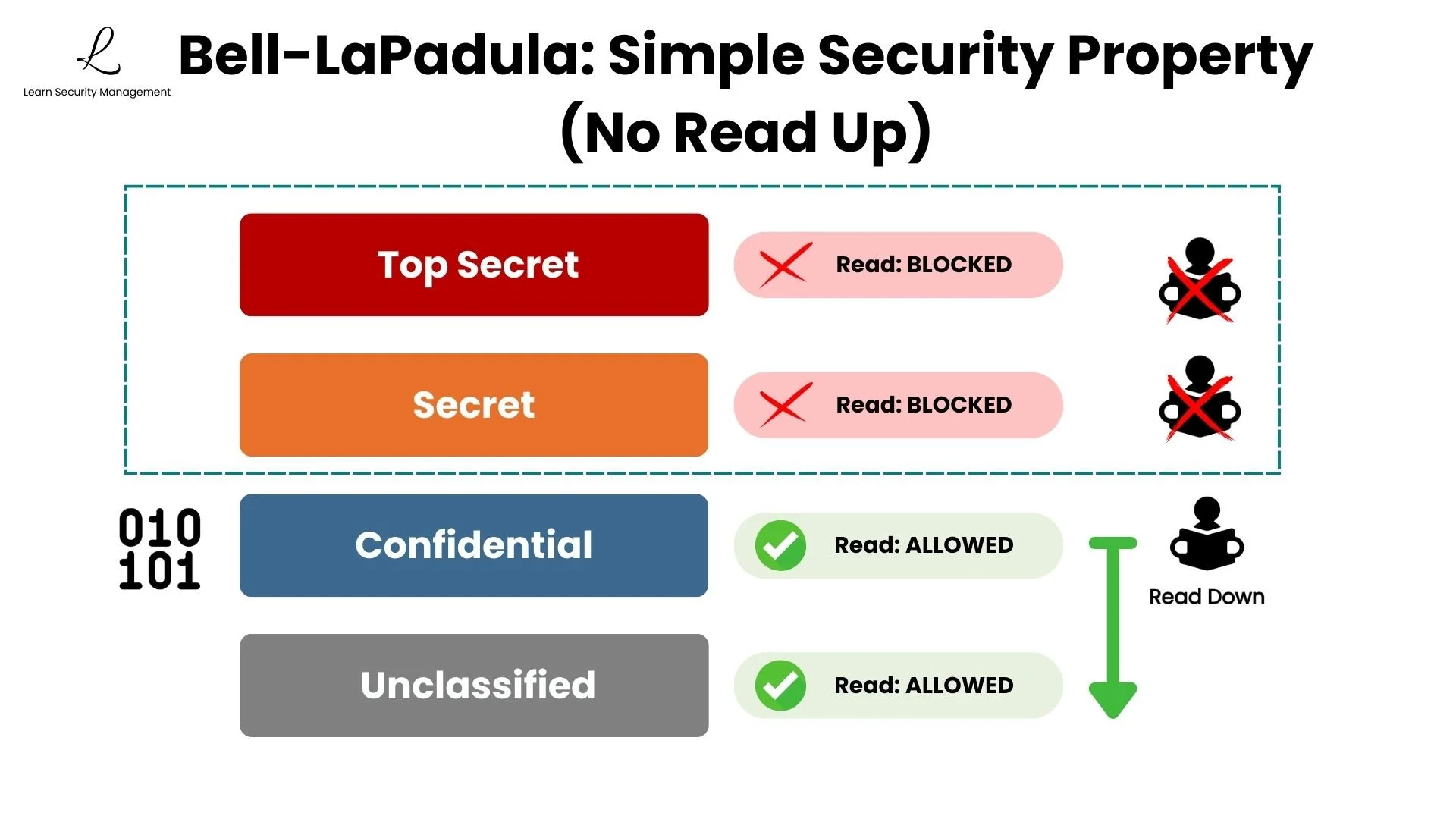
This creates an automatic barrier. Anything classified above your level is simply invisible to you. The system blocks access without any manual enforcement.
Picture a contractor with Confidential clearance helping to analyse logistics data. They can open everything at Confidential and Unclassified. The moment they try to open a Secret intelligence report about ongoing operations, the system denies them instantly. That is need-to-know enforced by architecture: the rule protects sensitive information from anyone who has not been cleared for that level of access.
Star Property (No Write Down)
The Star Property (written *-Property) is less obvious but equally critical: you cannot write data to a lower security level. Anything you write must be classified at or above your clearance level. It is often called the “write up” rule, because you can write at your level or higher, never downward.
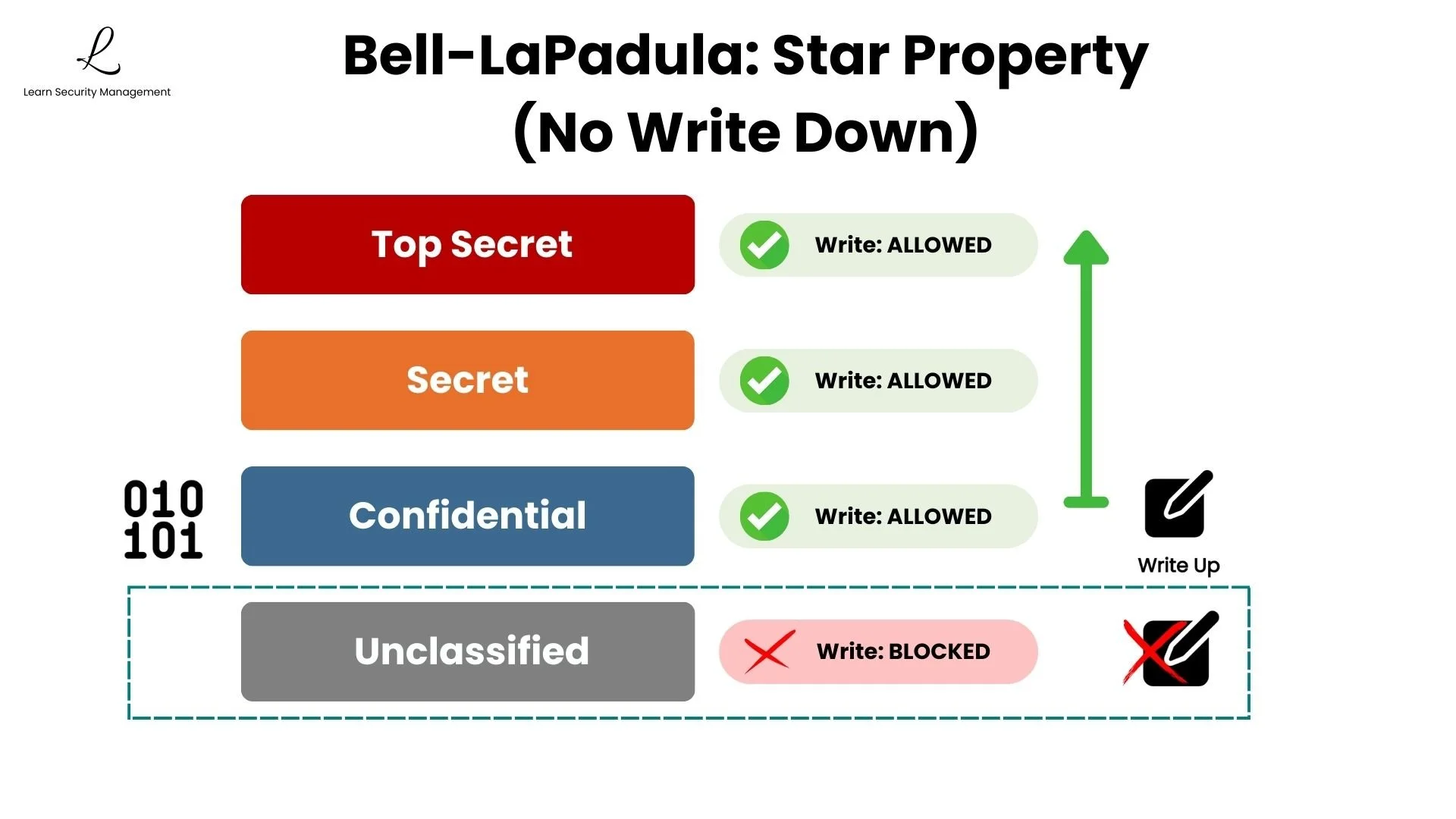
Why so strict? The system assumes your work may contain sensitive information from everything you have accessed. Imagine you are handling Top Secret intelligence. If you saved your analysis into a Secret folder, that Top Secret material would suddenly be readable by anyone with Secret clearance. The model treats your output as potentially containing everything you have read, so it forces you to save at your current level or higher. Information can only move upward in classification, never back down.
Pro tip: the blind write and the Strong Star Property. The standard Star Property allows writing to your level or higher. Writing above your level is sometimes called a “blind write”: you can put data into a container you cannot see inside. The Strong Star Property is a stricter variation that limits you to reading and writing at your exact security level only, removing blind writes entirely.
CISSP Exam Note. Memorise the rules as opposites of Biba. Bell-LaPadula is No Read Up, No Write Down. Biba is No Read Down, No Write Up. Same structure, opposite directions, different goals: Bell-LaPadula protects confidentiality, Biba protects integrity. The exam loves swapping these to see if you notice.
Putting It Together: A Military Example
A security officer with Top Secret clearance is analysing threat intelligence.
Reading (Simple Security Property). They can read documents at every level at or below theirs: Top Secret, Secret, Confidential, and Unclassified. Their clearance gives them full visibility downward.
Writing (Star Property). When they write their assessment, they must save it at Top Secret. They cannot save it into a Secret folder, even though they can read Secret data, because their report likely contains insights drawn from Top Secret sources. Saving it lower would expose those insights to users with only Secret clearance. That is a leak, and the Star Property exists to prevent exactly that.
The summary worth memorising:
- Reading: information flows down to you (you read from your level or lower)
- Writing: information flows up from you (you write to your level or higher)
- Result: classified data is protected from both unauthorized viewing (bad reads) and leakage (bad writes)
Bell-LaPadula vs Biba
Bell-LaPadula becomes much clearer when you set it beside Biba, its mirror image. The two are frequently tested together on the CISSP exam because they are structurally identical and directionally opposite.
| Aspect | Bell-LaPadula | Biba |
|---|---|---|
| Primary goal | Confidentiality | Integrity |
| Reading rule | No Read Up (read down only) | No Read Down (read up only) |
| Writing rule | No Write Down (write up only) | No Write Up (write down only) |
| Protects against | Unauthorized disclosure of secrets | Data corruption from untrusted sources |
| Typical use cases | Military and classified systems | Financial systems, databases, medical records |
The Fundamental Difference
Bell-LaPadula treats higher levels as more sensitive and protects them from exposure. Biba treats higher levels as more trusted and protects them from corruption. One keeps secrets from getting out; the other keeps errors from getting in.
Two contrasting scenarios make it concrete. In a military intelligence database running Bell-LaPadula, an analyst with Secret clearance cannot read Top Secret reports, and cannot save their own documents into Confidential folders. The system defends against espionage and disclosure. In a bank running Biba, an employee processing transactions cannot pull data from untrusted external feeds that might contain errors, and cannot modify high-integrity audit logs. The system defends against corruption and preserves accuracy.
Memory aid: espionage vs sabotage. Bell-LaPadula protects against espionage (stealing secrets, unauthorized viewing). Biba protects against sabotage (altering data, planting errors, corrupting logs). Bell-LaPadula hides the data; Biba protects the truth.
The sibling models complete the picture. Clark-Wilson protects commercial integrity through certified procedures rather than levels. Brewer and Nash prevents conflicts of interest with dynamic, history-based walls. Graham-Denning defines who may create, grant, and revoke the access rights the other models rely on.
Practical Limitations
Bell-LaPadula is theoretically strong but operationally awkward, and the exam expects you to know why.
| Limitation | Impact | Mitigation |
|---|---|---|
| No integrity protection | Authorized users could corrupt or delete data | Combine with Biba or other integrity controls |
| No availability protection | Does not prevent denial of service | Implement separate availability controls |
| Operational bottlenecks | Data accumulates at higher levels | Declassification processes and trusted subjects |
| Classification discipline | Requires strict security labelling | Automated classification and governance |
| Limited collaboration | Cross-level work is restricted | Defined escalation and review paths |
Single-Focus Design
The model addresses confidentiality and ignores everything else. An authorized user could delete files, corrupt data, or crash the system, and Bell-LaPadula would not object, because none of those are confidentiality violations. Real organisations layer it with integrity models like Biba and separate availability controls.
Data Flow Restrictions
Upward-only writing creates a practical problem: high-level systems accumulate more and more data that cannot flow back down, even when sharing it is legitimate and necessary. Information gets stuck at higher classifications, and organisations need formal declassification procedures and trusted subjects (entities permitted to violate the Star Property under controlled conditions) to move it down.
Critical understanding. Bell-LaPadula provides no protection for integrity or availability, only confidentiality. Comprehensive security always requires multiple complementary controls. Never assume a single model addresses all requirements: that assumption is itself a wrong answer waiting for you on the exam.
Conclusion
The Bell-LaPadula model provides a formal framework for protecting classified information through controlled information flow. The Simple Security Property (No Read Up) stops unauthorized access to sensitive data; the Star Property (No Write Down) stops classified information from leaking to lower levels. Together they guarantee that secrets can only flow upward, never down toward people who lack clearance.
Understanding how Bell-LaPadula differs from integrity models like Biba is non-negotiable for CISSP candidates. Biba uses the opposite rules (No Read Down, No Write Up) to protect data accuracy; Bell-LaPadula protects secrecy. The models complement each other in real architectures, and the exam tests whether you can tell them apart under scenario pressure.
When an exam scenario involves classified information, clearance levels, or preventing disclosure, Bell-LaPadula is your answer.
Ready to test that under exam conditions? Our LSM CISSP practice tests are built around exactly these scenario questions: security models, clearances, and the fine distinctions between them, with full explanations for every answer.
Quick Reference for the CISSP Exam
The Bell-LaPadula model protects data confidentiality by controlling information flow. It prevents unauthorized access to classified information and ensures sensitive data cannot leak to lower security levels.
The Two Core Properties
- Simple Security Property (No Read Up): users cannot read from higher classification levels. Prevents unauthorized access to classified information.
- Star Property (No Write Down): users cannot write to lower classification levels. Prevents classified information leaking downward.
Security Levels
- Top Secret: highest sensitivity, grave national security impact
- Secret: high sensitivity, serious national security impact
- Confidential: moderate sensitivity, damage to national security
- Unclassified: public or non-sensitive information
Bell-LaPadula vs Biba
- Bell-LaPadula: protects confidentiality. No Read Up, No Write Down. Higher means more sensitive.
- Biba: protects integrity. No Read Down, No Write Up. Higher means more trusted.
Common Exam Mistakes
- Confusing Bell-LaPadula rules with Biba rules (they are exact opposites)
- Assuming Bell-LaPadula provides integrity protection (it does not)
- Forgetting that security levels reflect sensitivity, not trustworthiness
- Overlooking that “higher” in Bell-LaPadula means more sensitive, not more trusted
Exam Focus: Spotting Bell-LaPadula in Scenarios
The exam tests security models as static, rule-based frameworks. Bell-LaPadula enforces fixed rules about information flow; it does not adapt to context or behaviour. Two patterns to recognise:
1. Espionage vs sabotage. If the threat actor wants to view or steal classified information, that is a confidentiality attack: Bell-LaPadula. If they want to corrupt or tamper with trusted records, that is an integrity attack: Biba.
2. What “up” means. In Bell-LaPadula, up means more classified (Top Secret sits above Secret). In Biba, up means more trusted (audited data sits above unverified input). Watch for keywords like “classified”, “sensitive”, “clearance”, and “disclosure”.
3. The manager takeaway. As a security manager, you apply Bell-LaPadula thinking when designing data classification and access policy: security clearances map to your vetting and access approval process, and classification levels map to your data labelling scheme (Public, Internal, Confidential, Restricted).
| Look for these keywords | Think Bell-LaPadula? |
|---|---|
| “Prevent unauthorized disclosure” | Yes |
| “Classified information” or “clearance levels” | Yes |
| “No Read Up, No Write Down” | Yes |
| “Prevent data corruption” or “maintain accuracy” | No (Biba) |
| “Military” or “government secrets” | Yes |
Bottom line: Bell-LaPadula is a one-way mirror. Those with clearance can see in, but secrets never leak out. When the exam asks about protecting classified data from espionage, Bell-LaPadula is your answer.