The Clark-Wilson model is the gold standard for commercial data integrity. Where other models focus on confidentiality or on preventing unauthorized disclosure, Clark-Wilson addresses the challenge businesses face every day: keeping data accurate, consistent, and protected from both accidental corruption and deliberate fraud.
The model is essential knowledge for CISSP candidates because it bridges theoretical access control and practical business requirements. Its two core mechanisms, well-formed transactions and separation of duties, work together to protect data integrity in exactly the way real businesses already operate, and Domain 3 (Security Architecture and Engineering) tests it regularly.
What is the Clark-Wilson Model?
The Clark-Wilson model is a security framework specifically designed to protect data integrity in commercial environments. Published in 1987 by David D. Clark and David R. Wilson, it addresses a fundamental business requirement: ensuring that critical data such as financial records, inventory counts, and transaction logs remains accurate and trustworthy.
Core Purpose: Commercial Data Integrity
Where Bell-LaPadula protects confidentiality and Biba protects integrity through classification levels, Clark-Wilson takes a distinctly commercial approach. It recognises that in business environments, the greatest threat to data integrity usually comes from authorized users: employees with legitimate access who might make errors or commit fraud. A hierarchy of trust levels does not stop a purchasing agent inventing a fake vendor; procedures and separation of duties do.
Key concept: two core mechanisms. Clark-Wilson protects integrity through two complementary properties. Certification ensures that procedures maintain data validity (through well-formed transactions). Enforcement controls who can execute those procedures (through separation of duties). Together they prevent both accidental corruption and intentional fraud.
What makes Clark-Wilson unique is its insistence on indirect access. Users never touch data directly. Every modification must go through a pre-approved procedure that enforces business rules and maintains consistency. Think of how a bank actually works: you cannot walk into the vault and adjust your balance by hand. You submit a transaction, and the bank’s process updates the ledger. Clark-Wilson formalises that instinct into an access control model.
Classifying Data for Protection
Clark-Wilson begins by dividing data into two categories based on how critical it is to protect. The classification determines which data lives under strict integrity controls and which can be handled freely.
Constrained Data Items (CDIs)
Constrained Data Items are the protected assets: critical business records subject to integrity controls and auditing. Bank account balances, inventory records, payroll data, financial transactions.
CDIs are “constrained” because they can only be modified through approved procedures, never directly. A bank balance is a CDI because errors cause financial loss and regulatory liability. Inventory records are CDIs because wrong counts cause stock shortages or waste. The defining characteristic: CDIs are the data the organisation cannot afford to have corrupted.
Unconstrained Data Items (UDIs)
Unconstrained Data Items live outside the model’s integrity controls. They can be modified freely without integrity checks: draft documents, user uploads, external data feeds that have not been validated.
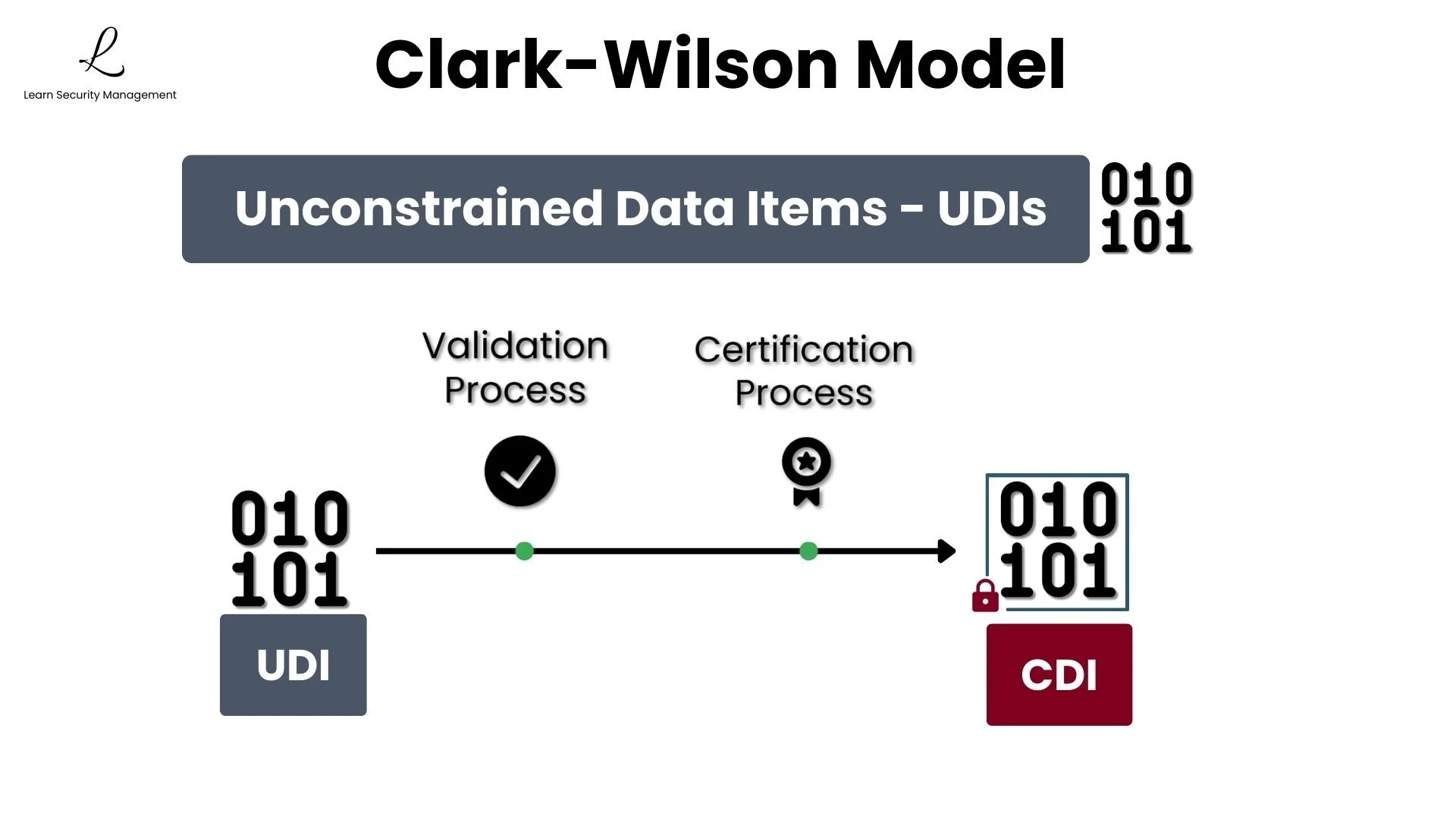
UDI to CDI transformation. When a UDI needs to become trusted data, it must pass through validation and certification before being promoted to CDI status. A customer’s uploaded spreadsheet (UDI) must be validated, checked against business rules, and formally accepted before its contents can update inventory records (CDI). Untrusted input never touches protected data directly.
Integrity Verification Procedures (IVPs)
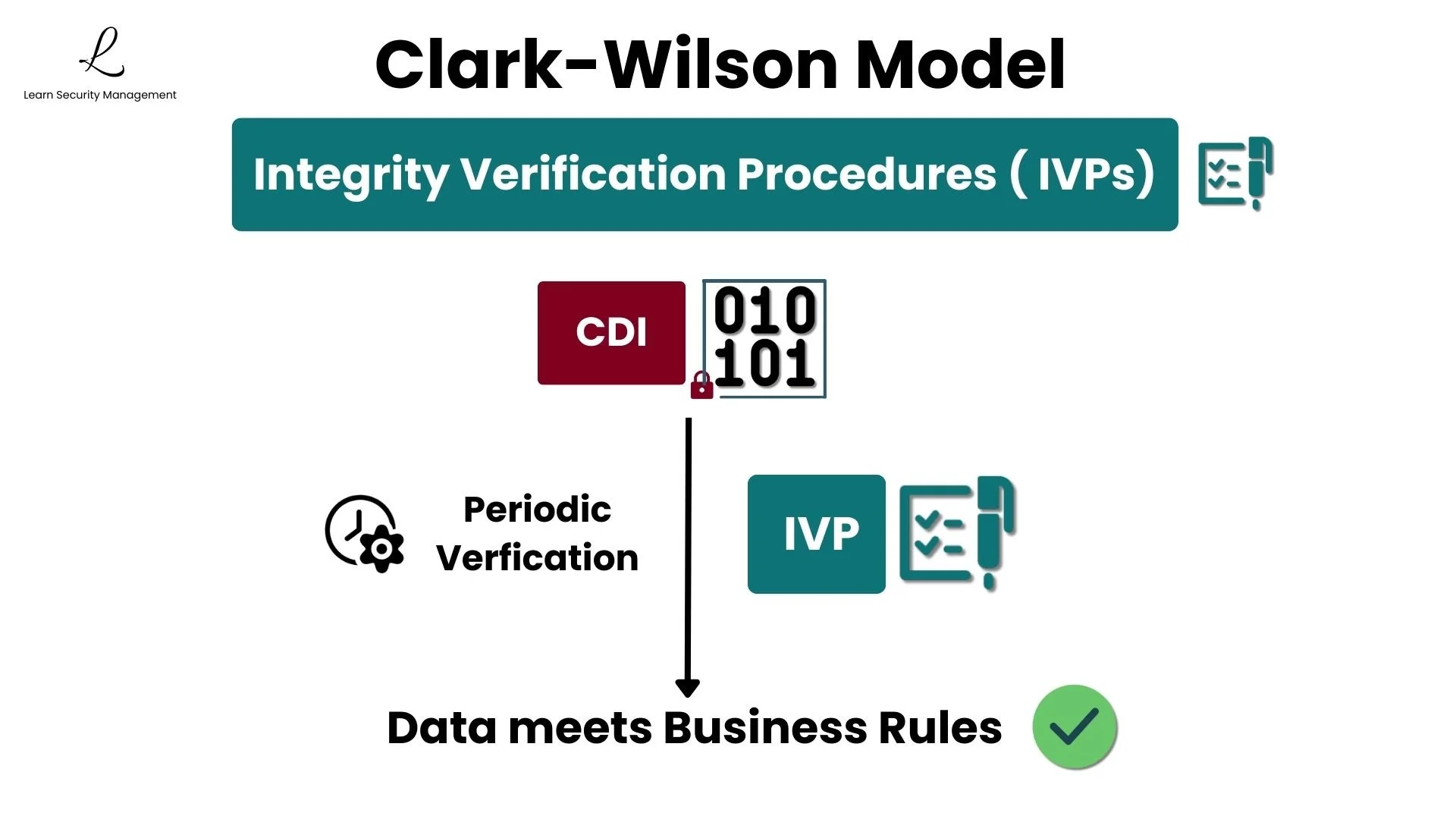
Once data is a CDI, how do we know it stays accurate? Clark-Wilson uses Integrity Verification Procedures: automated checks that confirm CDIs are in a valid state, running periodically or after transactions to verify the data still satisfies business rules.
An IVP might confirm that account balances are non-negative, that inventory quantities match physical counts, or that debits equal credits across related accounts. When a check fails, the discrepancy is flagged for review before the error can propagate through the system.
Controlling How Data Changes
IVPs verify that data is correct. But verification after the fact is not enough: we need to ensure changes cannot corrupt data in the first place. That is the job of Transformation Procedures, the heart of Clark-Wilson’s integrity protection.
Transformation Procedures (TPs)
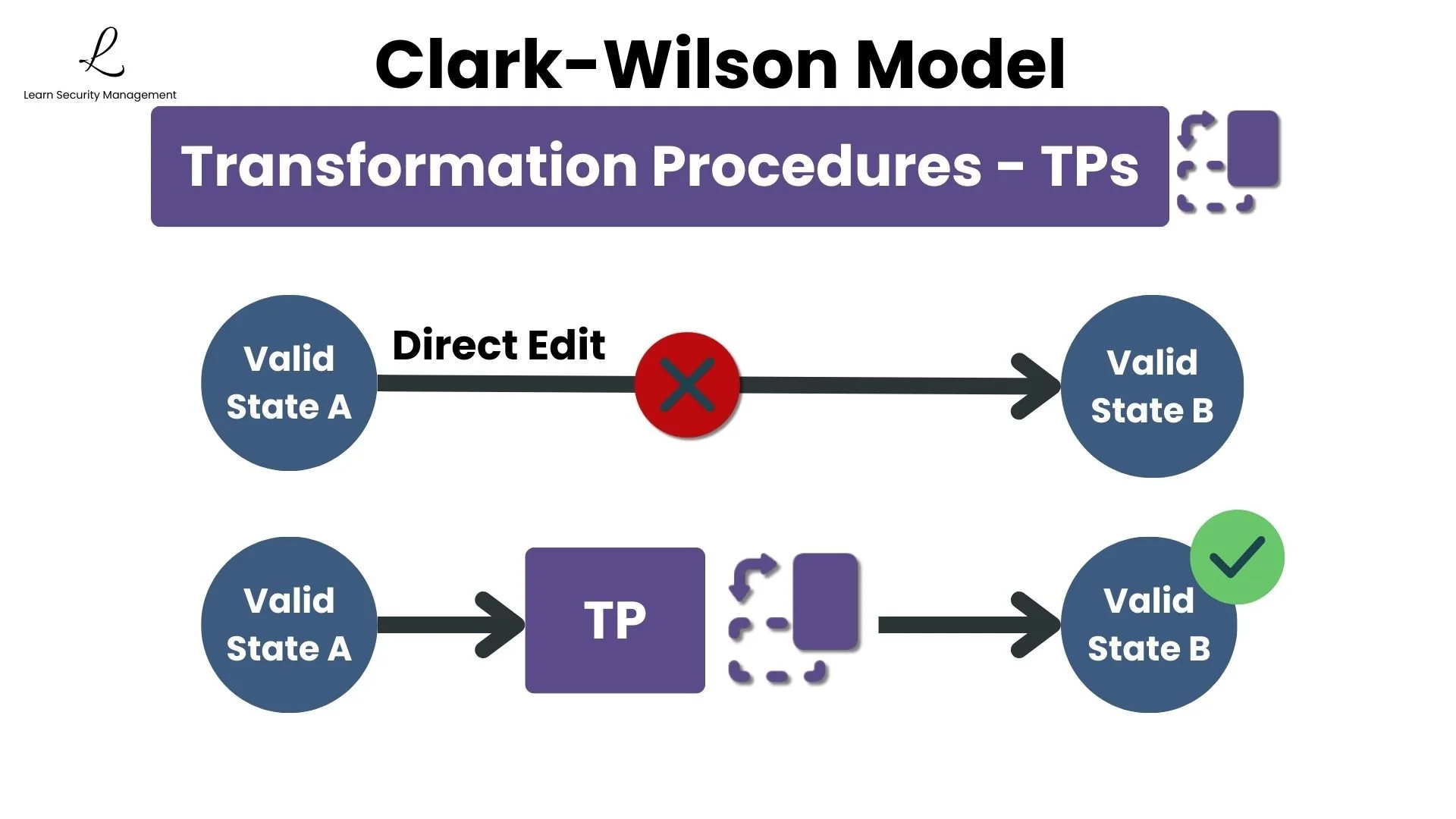
Clark-Wilson forbids direct access to CDIs. Users cannot open a database and edit values. Every modification must pass through a Transformation Procedure: a certified program or process that enforces all business rules and maintains data integrity.
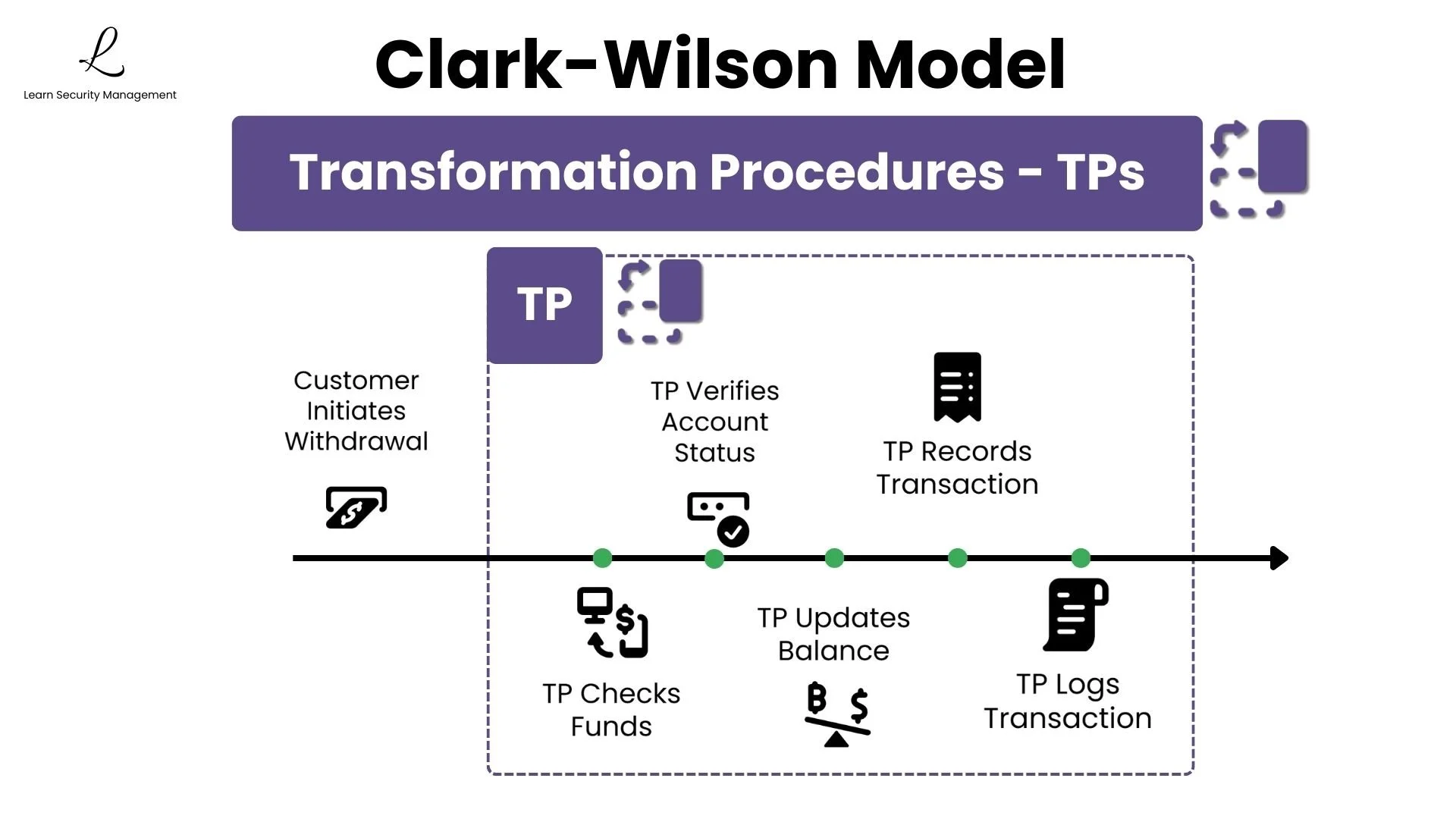
Think of a TP as a secure gateway. When a customer withdraws money, the withdrawal goes through a TP that checks available funds, verifies account status, updates the balance, and logs the transaction. All the business logic lives inside the TP. Try to bypass it, and you are blocked entirely.
CISSP Exam Note. A key distinction: in Clark-Wilson, users never have direct access to data. All access is mediated through Transformation Procedures. This is fundamentally different from Biba, where users may read and write data directly as long as the integrity-level rules allow it. “Access mediated through programs” is Clark-Wilson’s signature.
Well-Formed Transactions
Having a procedure is not enough; the procedure must be proven to preserve integrity. That is what a well-formed transaction guarantees: data moves from one valid state to another valid state, with no possibility of ending up inconsistent or corrupted in between.
Consider a funds transfer between two accounts. A well-formed transaction must debit one account and credit the other as an atomic operation: all or nothing. If the debit succeeds but the credit fails, the system rolls back the entire transaction. Money cannot vanish mid-transfer, and it cannot appear from nowhere.
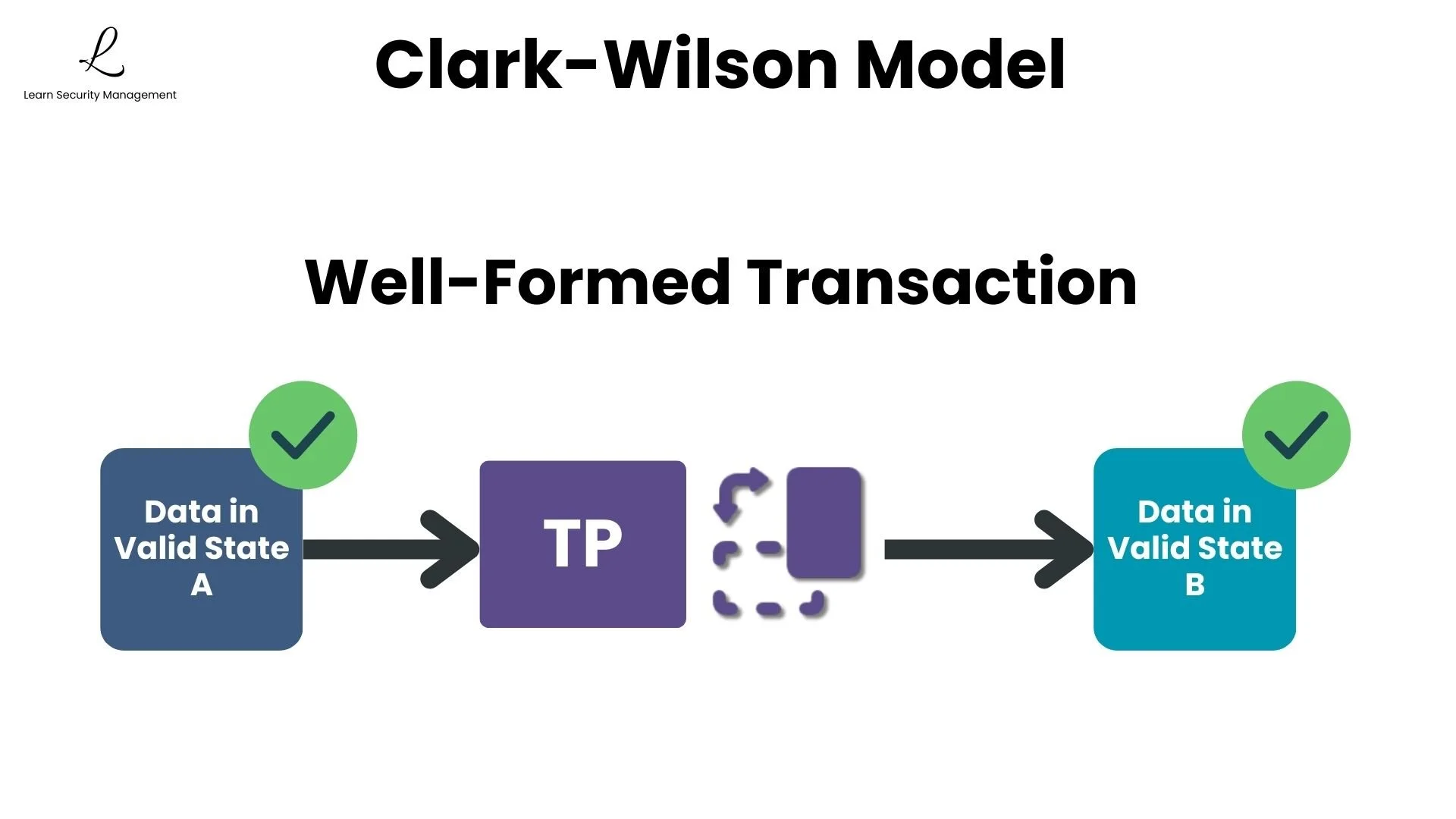
Key concept: the Certification property. Well-formed transactions and certified TPs embody Clark-Wilson’s Certification property: the quality control mechanism that ensures procedures preserve integrity. Procedures must be tested, validated, and certified before deployment, so that every state transition they perform is guaranteed valid.
Preventing Fraud Through Separation of Duties
Certified procedures alone are not enough, because the person running a perfectly correct procedure can still be the threat. Clark-Wilson implements its second mechanism, Enforcement, through separation of duties: no single person can compromise data integrity, even with legitimate access.
The Separation of Duties Principle
The principle is straightforward: different users must perform different transaction steps, and nobody should hold complete control over a critical process. Requiring multiple people to be involved in sensitive operations defeats both intentional fraud and unnoticed accidental error.
This is where Clark-Wilson departs from purely technical models. It acknowledges that authorized users are the biggest integrity risk. A purchasing agent who can both order goods and approve payments can invent fake vendors and steal money, and no clearance hierarchy will stop them. Splitting those steps between people creates checks and balances inside the organisation itself.
A classic illustration is the accounts payable three-way match. One person creates the purchase order. A different person receives the goods and creates a receiving report. A third person matches the invoice against both documents before authorising payment. No single employee can fabricate a purchase and pay themselves, because the fraud would need three colluding people rather than one opportunist.
Access Control Triplets
Clark-Wilson enforces separation of duties through a precise mechanism: access control triplets. Each triplet defines exactly which user can perform which action on which data, creating granular control that prevents unauthorized or conflicting access.
The Three Components
Each triplet binds three elements: a user (person or role), a Transformation Procedure (the action they can perform), and a Constrained Data Item (the data reachable through that procedure). Unless all three match an authorized triplet, access is denied.
| User/Role | Transformation Procedure | Constrained Data Item |
|---|---|---|
| Bank teller | Process withdrawal | Customer accounts |
| Loan officer | Approve loan | Loan applications |
| Auditor | Generate report | Transaction logs |
How Triplets Enforce Separation
In the banking example, a teller holds the authorized triplet (Teller, Process Withdrawal, Customer Accounts), so they can process withdrawals. They hold no triplet for (Teller, Approve Loan, Loan Applications), so they cannot approve loans, even though they work at the same bank and might see application data in passing.
A loan officer holds (Loan Officer, Approve Loan, Loan Applications) but no withdrawal triplet, so they cannot process withdrawals. Every role’s reach is defined exactly by its authorized triplets, and separation of duties falls out naturally: no single employee ever holds the full set of triplets needed to complete a high-risk transaction alone.
CISSP Exam Note. Access control triplets are unique to Clark-Wilson. When a question mentions triplets of (user, program or procedure, data), the answer involves Clark-Wilson. This is distinct from the general subject-object-rights structure used in other frameworks such as Graham-Denning, which governs how rights are granted and transferred rather than forcing access through certified programs.
Implementation Requirements
Clark-Wilson demands real organisational commitment. It fits environments where data accuracy is critical, but it requires upfront investment to implement properly.
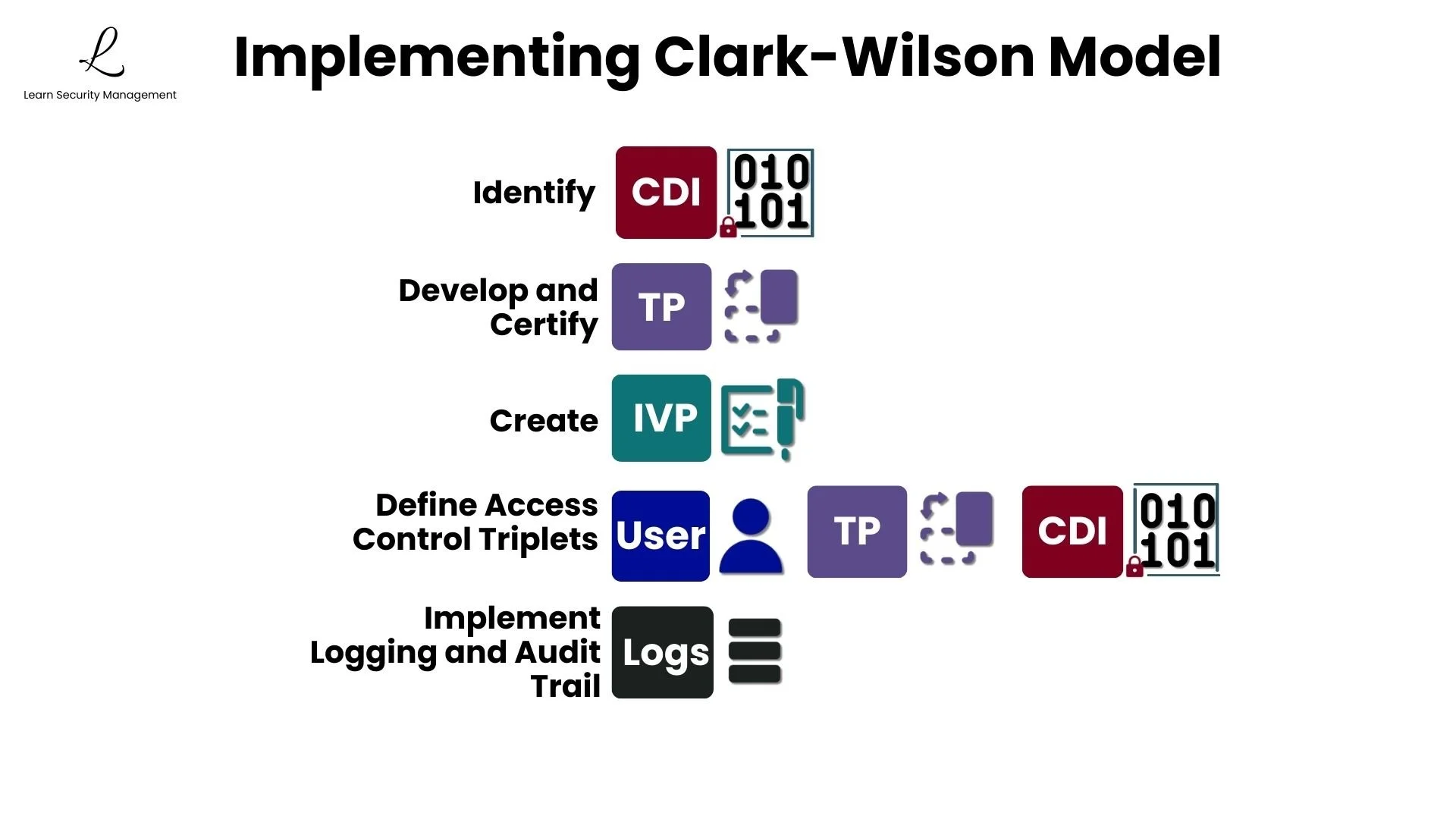
Five Implementation Steps
- Identify CDIs: determine which data assets require integrity protection.
- Develop and certify TPs: create transformation procedures with proven integrity preservation.
- Create IVPs: implement integrity verification procedures to validate data states.
- Define access control triplets: specify which users can execute which procedures on which data.
- Implement logging and audit trails: record every transaction for accountability.
Critical understanding. Clark-Wilson addresses data integrity only. It provides no inherent confidentiality or availability protection, so organisations combine it with other controls (such as Bell-LaPadula for confidentiality) for comprehensive security. The model also needs ongoing maintenance: as business processes evolve, TPs must be re-certified and triplets updated, or the integrity guarantees quietly decay.
Conclusion
The Clark-Wilson model earns its place as the gold standard for commercial data integrity by combining well-formed transactions with separation of duties. Data is classified into CDIs and UDIs, every modification is mediated through certified Transformation Procedures, and access control triplets ensure that no individual can complete a high-risk process alone. The result is protection against both accidental corruption and intentional fraud, the two threats commercial systems actually face.
For the exam, keep the two properties straight: Certification ensures procedures preserve integrity (quality control), and Enforcement controls who can execute those procedures (access control). And keep Clark-Wilson distinct from its siblings: Biba also protects integrity but through levels and direct access rules, Brewer and Nash prevents conflicts of interest dynamically, and Graham-Denning manages the lifecycle of access rights themselves.
When a scenario involves commercial integrity, fraud prevention through separation of duties, or users reaching data only through approved programs, Clark-Wilson is your answer. When you see “well-formed transactions”, “access control triplets”, or “Transformation Procedures”, stop reading the distractors: think Clark-Wilson.
To drill these distinctions the way the exam presents them, try our LSM CISSP practice tests: scenario-based questions across all eight domains with detailed explanations, including the security models that trip most candidates.
Quick Reference for the CISSP Exam
The Clark-Wilson model protects commercial data integrity through well-formed transactions and separation of duties. Users can only modify protected data through certified procedures, never directly.
Data Classification
- CDIs (Constrained Data Items): protected data requiring integrity controls (financial records, inventory)
- UDIs (Unconstrained Data Items): uncontrolled data that can be modified freely (uploads, drafts)
- IVPs (Integrity Verification Procedures): automated checks validating CDI integrity
Access Control Mechanisms
- Transformation Procedures (TPs): certified programs that mediate all access to CDIs
- Well-formed transactions: operations that move data from one valid state to another
- Access control triplets: (user, TP, CDI) combinations defining authorized access
Two Core Properties
- Certification: ensures procedures preserve data integrity (quality control)
- Enforcement: controls who can execute which procedures (access control)
Key Characteristics
- Indirect access: users never touch data directly, always through TPs
- Separation of duties: no single user can complete critical transactions alone
- Commercial focus: designed for business environments where accuracy matters
Common Exam Scenarios
- Banking systems requiring transaction integrity
- Inventory management preventing fraud
- Financial systems with audit requirements
- Any scenario mentioning “well-formed transactions” or “triplets”
Exam Focus: Model Comparison
To identify the correct model instantly:
- Threat is unauthorized disclosure (espionage, leaking secrets): Bell-LaPadula
- Threat is data corruption through untrusted flows (sabotage, integrity labels): Biba
- Threat is commercial fraud (fraudulent transactions, business integrity): Clark-Wilson
- Threat is conflict of interest (competing clients, ethical walls): Brewer and Nash
Managerial takeaway: Bell-LaPadula hides secrets, Biba protects truth through labels, Clark-Wilson prevents fraud through procedures, Brewer and Nash prevents ethical violations.